
Wayfinding Signage Design in Dubai: Offices, Malls, and Commercial Buildings
Good wayfinding signage is invisible — people find their way without thinking about it. Bad wayfinding creates confusion and frustration. This guide covers how to design and specify wayfinding systems for Dubai commercial buildings.
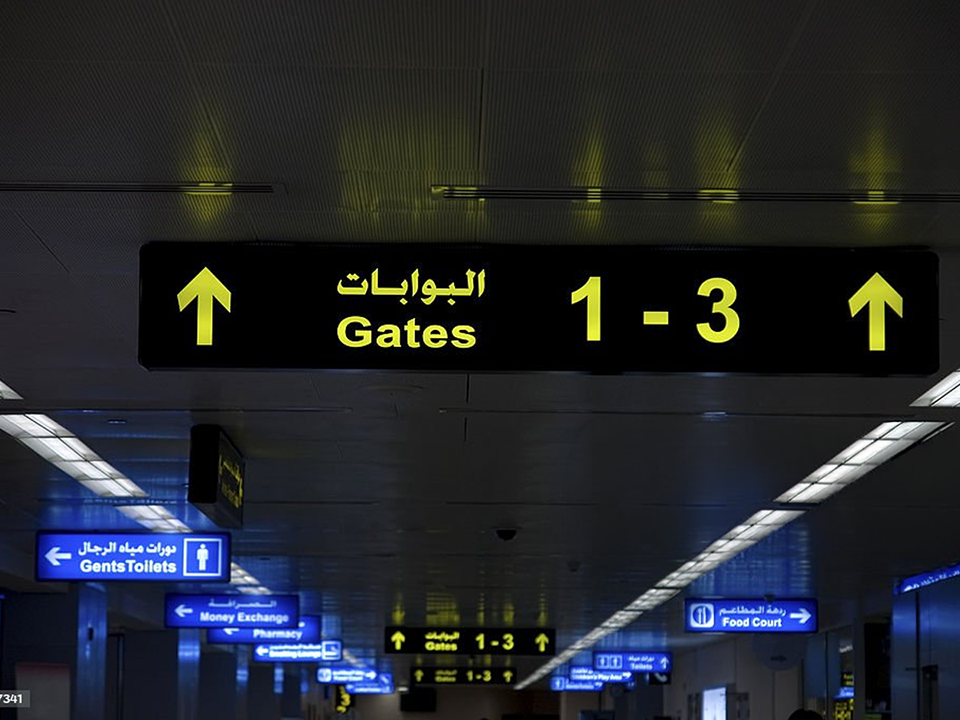
Good wayfinding signage is invisible. When it works, people move through a building confidently and efficiently without consciously thinking about the signs. When it fails, the result is confusion, frustration, and a poor experience that reflects badly on the building and its occupants.
In Dubai's commercial buildings — the multi-tenant office towers of Business Bay and DIFC, the sprawling malls of Dubai Mall and Mall of the Emirates, the free zone campuses of DIP and JAFZA — wayfinding is a complex design challenge. This guide covers the principles, components, and specifications for effective wayfinding systems.
What Is a Wayfinding System?
A wayfinding system is the complete set of signs, maps, and visual cues that help people navigate a building or campus. It is a system — not a collection of individual signs — because the signs must work together to guide people through a journey from arrival to destination.
A complete wayfinding system typically includes:
- Identification signs — identify a location (room name, floor number, building name)
- Directional signs — point the way to destinations
- Orientation signs — show where you are (floor maps, building directories)
- Regulatory signs — communicate rules (no entry, fire exit, accessible route)
The Wayfinding Design Process
1. User Journey Mapping
Before designing any signs, map the journeys that users take through the building. Who are the users? Where do they arrive? Where do they need to go? What are the decision points — the moments where they need information to choose a direction?
For a Dubai office building, typical journeys include:
- Visitor arriving at the main entrance → reception → meeting room
- Employee arriving at the car park → lift lobby → their floor → their desk
- Delivery driver → loading bay → goods lift → specific floor
Each journey has different information needs at different points.
2. Sign Location Planning
Place signs at every decision point — every junction, every lift lobby, every entrance. Signs should be visible before the decision point, not after it. A sign that tells you to turn left after you have already passed the turning is useless.
3. Information Hierarchy
Each sign should carry only the information needed at that decision point. A directional sign in a corridor does not need to list every destination in the building — only the destinations accessible from that corridor. Overloaded signs are ignored.
4. Consistent Visual Language
All signs in the system should share a consistent visual language: the same typeface, the same colour coding, the same arrow style, the same mounting height. Consistency builds trust — users learn the system quickly and navigate confidently.
Sign Types and Specifications
Building Directory
The primary orientation tool at the main entrance. Lists all tenants or destinations by floor. Typically a large panel (600mm–1,200mm wide) with a floor-by-floor listing.
Materials: Aluminium frame with printed insert (changeable), or digital display for buildings with frequent tenant changes
Cost: AED 1,500–AED 6,000
Floor Directory
A smaller version of the building directory, located at each lift lobby. Shows the destinations on that floor.
Materials: Aluminium or acrylic panel with printed or changeable insert
Cost: AED 600–AED 2,500 per floor
Directional Signs (Overhead or Wall-Mounted)
Arrow signs pointing to destinations. Overhead signs (ceiling-hung or projecting from the wall) are more visible in busy corridors than wall-mounted signs.
Materials: Aluminium extrusion system with printed inserts, or acrylic panels
Cost: AED 200–AED 800 per sign
Room Identification Signs
Mounted adjacent to each door. Shows the room name or number. In Dubai's bilingual environment, Arabic and English are standard.
Materials: Acrylic, aluminium, or brushed steel
Cost: AED 120–AED 600 per sign
Accessible Route Signs
Required in buildings that must comply with UAE accessibility standards (Federal Law No. 29 of 2006). Indicate accessible routes, lifts, and facilities.
Materials: As per ISO 7001 (accessibility symbols)
Cost: AED 150–AED 500 per sign
Material Options for Dubai Commercial Buildings
Aluminium Extrusion Systems
The most common choice for corporate buildings. Modular aluminium extrusion frames with printed or engraved inserts. Inserts can be changed without replacing the frame — important for buildings with changing tenants.
Best for: Multi-tenant office buildings, free zone campuses
Finish options: Anodised silver, powder-coated (any RAL colour), brushed
Acrylic
Popular for modern, design-led interiors. Clear, frosted, or coloured acrylic with printed or engraved text. Less flexible than aluminium systems for content changes.
Best for: Single-tenant offices, retail, hospitality
Finish options: Clear, frosted, coloured, mirror
Brushed Stainless Steel
Premium choice for luxury buildings, hotels, and high-end retail. Durable, elegant, and easy to clean.
Best for: Hotels, luxury retail, premium office buildings
Finish options: Brushed, mirror-polished, PVD-coated (gold, bronze, black)
Bilingual Wayfinding in Dubai
All wayfinding signage in Dubai's public and commercial buildings should be bilingual — Arabic and English. This is a regulatory requirement in many building types and a practical necessity given Dubai's diverse population.
Key considerations for bilingual wayfinding:
- Arabic reads right-to-left; English reads left-to-right. Layout must accommodate both
- Arabic text requires more vertical space than the equivalent English text
- Arrows should be positioned to avoid ambiguity in bilingual layouts
Sign Design Dubai produces all wayfinding signage in bilingual format as standard.
Cost Guide
| Project Type | Approximate Cost |
|---|---|
| Single-floor office wayfinding (20 signs) | AED 6,000–AED 15,000 |
| Multi-floor office building (5 floors, 80 signs) | AED 20,000–AED 50,000 |
| Mall or retail complex wayfinding system | AED 40,000–AED 150,000+ |
| Free zone campus wayfinding | AED 30,000–AED 100,000+ |
Get a quote for your wayfinding system or call +971 4 255 0366. We design, fabricate, and install wayfinding systems across Dubai and the UAE.
Explore Topics
Written by
Sign Design Dubai Team
Content creator and writer sharing insights and stories.
Found this useful?
Share it with your team or save it for later.
